Amazing things have happened in this second semester. This is Tyler. He is eating salad for the second time in his life. (The first time was in our class, too.) What you don't see is when he licked his plate after finishing his lettuce.
Everybody loved the salad we made; this bowl was filled many times!
Another favorite turned out to be Swiss Chard Quiche, which we made today. One more harvest of lettuce, and school is out!
Tuesday, May 29, 2012
Spring Gardening
It has been too long since we've added anything to the Garden Blog. During the second semester we finished our greenhouse harvests of beets, carrots, bok choi, lettuce, Swiss chard, and spinach. The winter greenhouse was a tremendous success, despite the fact that we planted in the late fall.
Our raised beds brought us enough vegetables for classroom cooking and sharing. We made sweet beet cookies and pasta with bacon and greens, among other things...
Saturday, January 14, 2012
Glenvar Garden Soup
On the last day of the semester we used our final garden harvests to make our own "Glenvar Garden Soup" with everything we grew. The only things we purchased were canned tomatoes, chicken broth, and pasta.
Here, Jordan slices the carrots he grew.
Dominga and Noah chop the leaves of kohlrabi and red cabbage.
Kohlrabi forms bulbs at the base of its stem, and Conner sliced these into bite-sized pieces.
We added our onions, a few Brussels sprouts, and turnips from Mr. Noland's garden, some pasta, and cooked it for about 45 minutes. Yum!!
Look for the link to our recipe on our blog.
Dustin and Jared Make Spanakopita
Before Christmas, Dustin found a recipe for "Green Greek Slices" in a cookbook he was reading. Turns out it's a great recipe for Spanakopita, a classic Greek favorite and very labor-intensive to make. This week, with the help of Jared, they spent their 3rd block in my room creating a masterpiece with 16 sheets of phyllo dough and lots of garden vegetables. This was their contribution to a farewell gathering for Mrs. Neely.
We didn't get a picture of the finished product, either unbaked or baked, but it was quite beautiful. After their hard work putting it together they washed and dried every dish!
The spanakopita was absolutely delicious!
Harvesting from the Cold Frames
During the week of January 9 we made our last trip to the garden to harvest the remainder of the vegetables that had been sheltered in the two cold frames. After nights of below freezing temperatures, the cold frames were covered in ice.
However, when we opened them, we found lots of green, healthy vegetables!
From the two gardens we cut kohlrabi, red cabbage, lettuce, and Brussels sprouts, pulled onions and carrots, and transplanted 5 cauliflower plants to the greenhouse.
From the cold frames we had enough vegetables for a big pot of "garden soup" for each class, as well as greens for Dustin's Spanakopita (see another post) and a large salad for 4th block to enjoy.
Monday, November 7, 2011
Cooking what we Harvest
Over the last few weeks we've done a lot of cooking with the harvests of the fall garden. Here, Morgan and Montana enjoy Roasted Turnip Salad; the turnips were a gift from Mr. Nolen, our PE teacher. We used our Oriental greens, Italian cress, and lettuce. With the turnips we also made Crispy Turnip Fries and Braised Turnips (AKA: Turnips with Bacon).
Next we used the cress in Garden Corn Bread, and added more of our greens to make our favorite Mixed Green Salad. The dressing is the best! We used fresh garlic from last year's garden.
We also enjoyed Pickled Radishes with our salad, and last Friday we enjoyed Chinese Mustard Green Soup on a cold day.
Next we used the cress in Garden Corn Bread, and added more of our greens to make our favorite Mixed Green Salad. The dressing is the best! We used fresh garlic from last year's garden.
We also enjoyed Pickled Radishes with our salad, and last Friday we enjoyed Chinese Mustard Green Soup on a cold day.
November Harvests
After nights of freezing temperatures, we checked last Monday to see how the plants survived. The gardens have grown abundantly with the warm fall days and plentiful rain, and we have just begun to harvest them regularly.
If you look closely, you can see the melting frost on the leaves...
Everything looked even better than the week before! Obviously, these plants love cold, fall days and nights.
Sarah made a final harvest of her Easter Egg radishes.
If you look closely, you can see the melting frost on the leaves...
Everything looked even better than the week before! Obviously, these plants love cold, fall days and nights.
Sarah made a final harvest of her Easter Egg radishes.
Monday, October 31, 2011
Weeding and Watering: October 5 and 6, 2011
The Italian cress was the first plant to grow large:
We spent a warm afternoon pulling weeds from our new seedlings:
Then it was time to water the plants:
We spent a warm afternoon pulling weeds from our new seedlings:
Then it was time to water the plants:
Monday, September 26, 2011
Thinning the Seedlings
Today we were happy to see sprouts in almost every garden square. The rainy weather has been good for our gardens. Unfortunately, when you plant 2 seeds in one hole and both of them grow, only one can stay...
Wednesday, September 21, 2011
Gardening in Rainy Weather
Today we used the rainy weather to finish up some last-minute planting and add some fertilizer to our well-used soil. We are already seeing tiny plants popping through, even though they've been in the ground less than a week!
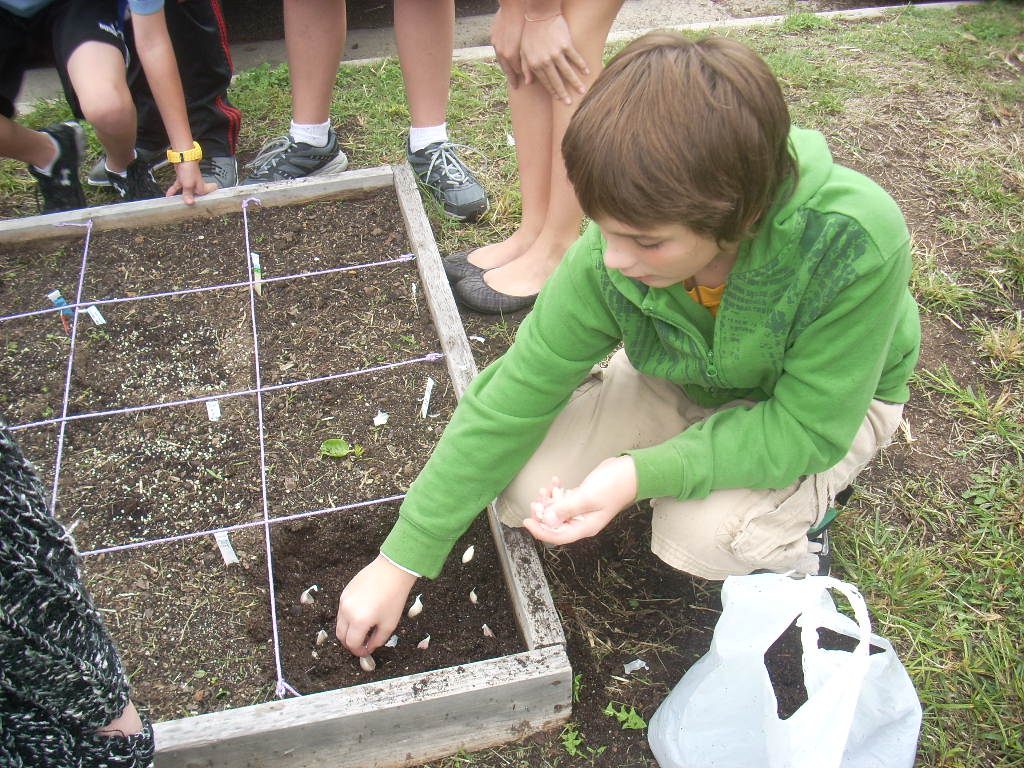
Reuben dug out several inches of soil and placed garlic cloves in his square before covering them up again. He's agreed to patiently wait for the June garden harvest, knowing the rewards might be enjoyable! (He'll get to eat our garden food again next semester, unlike everyone else.)
Meanwhile, everyone else sprinkled their squares with two kinds of fertilizer. We added a little organic blood meal for instant nitrogen to get our plants started, and we also added a small amount of slow-release fertilizer to be there as they grow. The rain should wash the fertilizer into the soil, so we hope this is perfect timing.
Reuben dug out several inches of soil and placed garlic cloves in his square before covering them up again. He's agreed to patiently wait for the June garden harvest, knowing the rewards might be enjoyable! (He'll get to eat our garden food again next semester, unlike everyone else.)
Meanwhile, everyone else sprinkled their squares with two kinds of fertilizer. We added a little organic blood meal for instant nitrogen to get our plants started, and we also added a small amount of slow-release fertilizer to be there as they grow. The rain should wash the fertilizer into the soil, so we hope this is perfect timing.
Friday, September 16, 2011
Fall Planting: September
Today we finished planting 4 Brussels sprouts seedlings, and the following seeds:
- onions
- radishes
- red cabbage
- Swiss chard
- kohlrabi
- lettuce (lots of kinds!)
- cauliflower
- bok choy
- carrots
- Asian greens
- cress
- spinach
- mustard greens
- beets
Uncovering the Gardens: August 2011
On August 29th we opened the gardens to see how they faired under the black plastic during the hot summer months.
The bad news was that the weeds somehow found the tiniest spaces in which to grow.
The really good news is that some gardens were free from all weeds AND wire grass! That's a big improvement from previous years.
This rhinoceros beetle didn't survive the heat. Read more about it below:
The bad news was that the weeds somehow found the tiniest spaces in which to grow.
The really good news is that some gardens were free from all weeds AND wire grass! That's a big improvement from previous years.
This rhinoceros beetle didn't survive the heat. Read more about it below:
Grants' Rhinoceros Beetle
(Dynastes granti)
by Jon Fouskaris & Orin McMonigle
(Dynastes granti)
by Jon Fouskaris & Orin McMonigle
ADULT MALES Specimen provided by US Insects. Photo taken by US Insects. | Grants' Rhinoceros Beetle is the longest of the US rhinoceros beetles with the record specimen at 85mm (3.25 inches)! It is a very impressive beetle with a heavy build. Females resemble monstrous spotted June beetles while the males look much more exotic and possess a horn on both the pronotum and head. The horns of the male are used in fighting over females and food. Smaller males can have very tiny horns although properly feeding larvae will produce all major males, like the captive-bred males pictured to the left. In the wild, Grants' Rhinoceros Beetles can be found out at night feeding on tree sap. In captivity, maintaining these beetles is much easier. Unlike many other invertebrates, Grants' Rhinoceros Beetles don't seem to get stressed out by being handled and gently played with by people. They also do not pose a threat to humans when bites and stings are concerned, therefore, these giant beetles make excellent pets! The Grants' Rhinoceros Beetle only lives for one or two years, but it's still an invertebrate worth keeping. They have been becoming more popular lately, and it is easy to see why. The Grants' Rhinoceros Beetle is a perfect combination of simple care, good temperament, and large size. |
Subscribe to:
Posts (Atom)